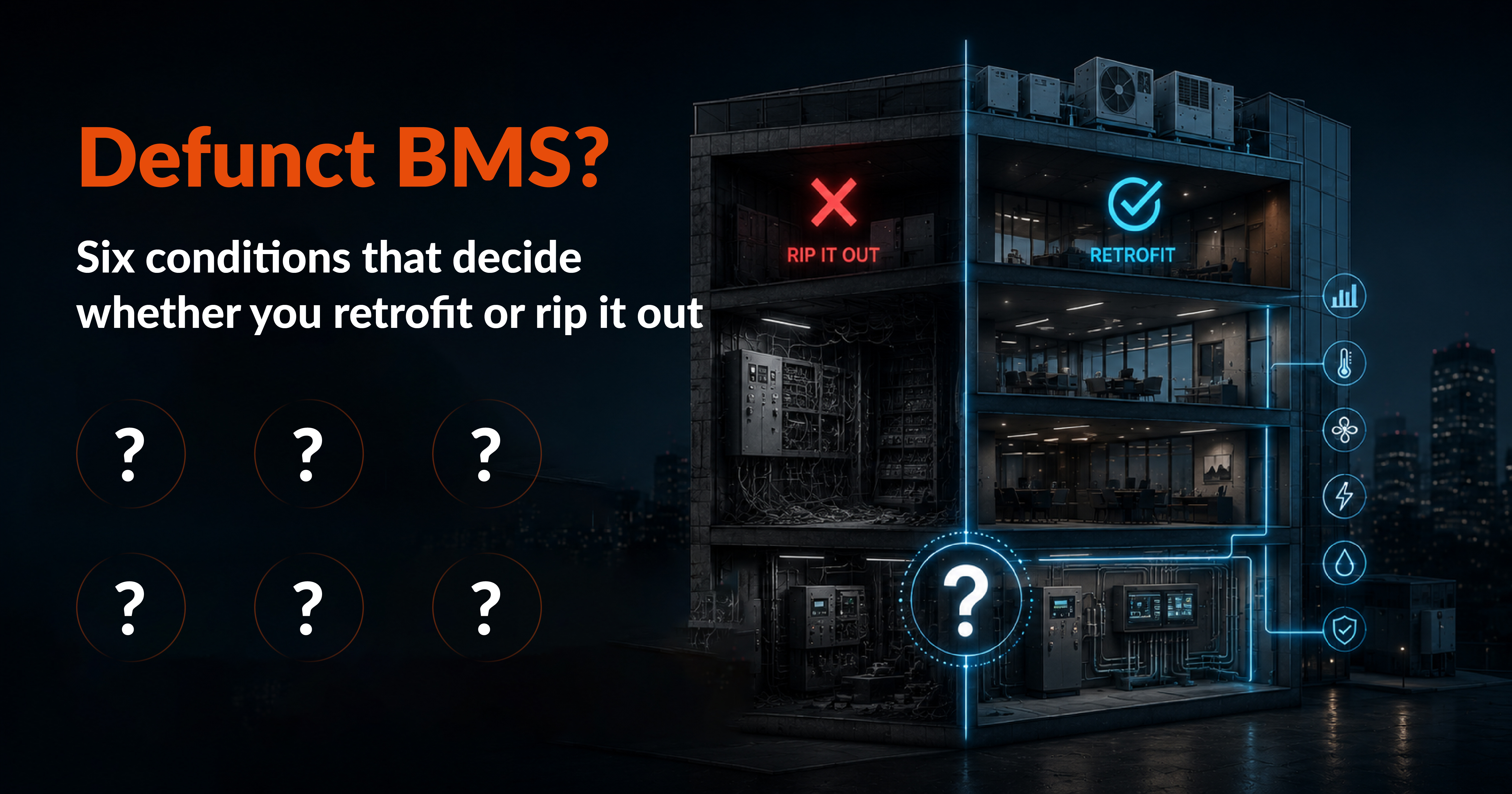
Defunct BMS: Six conditions that determine whether you retrofit or replace
- IBMS
There is a version of this conversation that facility managers dread. The BMS dashboard is dark, half the sensors haven't reported in weeks, and someone in the room is already quoting a full rip-and-replace. On the other side of the table, someone else is insisting the system just needs a software patch and a few new controllers. Both are making the same mistake: they've already decided before asking the right question.
The right question isn't can this system be saved? It's should it be?
That shift in framing matters enormously. A defunct BMS is rarely completely dead. More often it's what engineers sometimes call a zombie state — controllers still executing last-known sequences, sensors still outputting values (often badly calibrated ones), but the intelligence layer is gone. The building hasn't stopped functioning. It's stopped functioning intelligently. And the cost of that distinction accumulates every single day in wasted energy, reactive maintenance, and comfort complaints.
Whether you retrofit or replace hinges on an honest assessment of six specific failure conditions. Get this analysis right, and you protect your capital budget. Get it wrong in either direction — reviving what should be replaced, or replacing what could be revived — and you're either pouring money into a sinking system or destroying reusable infrastructure unnecessarily.
The case for retrofitting: Why revival often makes sense
Before walking through the six conditions, it's worth establishing why retrofit deserves to be taken seriously as a primary option — not just a consolation prize for clients with tight budgets.
The most expensive component of any BMS installation isn't the software license or the head-end workstation. It's the field infrastructure: the sensors, actuators, cabling runs, conduit, junction boxes, and automation cabinets installed across a building's mechanical and electrical systems. This infrastructure takes years to install and significant disruption to replace.
Retrofit approaches that preserve this layer, while upgrading the intelligence on top of it, represent genuine value engineering. Modern IoT overlays can retain existing control points, cabling, and automation cabinets as a foundation, layering new controllers and analytics capability without touching the field layer. For occupied buildings like hotels, hospitals, and retail malls where a six-month shutdown is simply not viable, this matters enormously.
The energy argument strengthens the case further. A properly configured building energy management system can reduce energy consumption by up to 30%, with some facilities reporting savings as high as 47% after a comprehensive retrofit. Every month a building operates without intelligent control, it loses energy spend that it will never recover.
So retrofit isn't the easy option or the cheap option. In many cases, it's the smart option. But only when the underlying conditions support it.
The six conditions that kill the revival conversation
Six conditions that kill the retrofit case
Any two present simultaneously → replace, don't revive
Vendor lock-in
No exit path exists from proprietary ecosystem
EOL controllers
No replacement supply chain available
Cybersecurity risk
Legacy protocols with unresolvable exposure
Interop gaps
Proprietary protocols, no gateway options
Field device failure
50%+ sensors and actuators degraded
Maintenance spiral
Costs rising with no performance improvement
→ Retrofit
Field wiring intact, actuators functional, failure is at the head-end or software layer
→ Replace
2+ conditions present simultaneously, compounding risk exposure across layers
Do nothing = hidden cost
25-40% energy waste compounding every month
Any one of these conditions is a yellow flag. When two or more occur simultaneously, the retrofit case typically collapses.
1. Vendor lock-in with no exit path
The traditional BMS business model has long relied on proprietary ecosystems — equipment, platforms, and software that require costly licenses, manufacturer-exclusive maintenance contracts, and opaque documentation. Facilities that have been running a single-vendor BMS for fifteen years often discover, when that relationship breaks down, that they don't actually own the operational knowledge to run their own building.
Reviving a system entrenched in this model without fundamentally breaking the lock-in isn't a retrofit. It's re-entering the same trap with older hardware. If the vendor is no longer willing or able to support the system and there is no documented open-protocol pathway out, revival simply defers the crisis.
2. End-of-life controllers with no replacement supply
Hardware obsolescence is unambiguous. When a manufacturer has discontinued a controller line, when compatible replacement units are no longer available through normal supply channels, and when third-party repair options have dried up, the infrastructure argument for retrofit disappears.
No software overlay, however sophisticated, can compensate for dead hardware with no supply chain. If your control architecture depends on components that cannot be sourced, the building's future depends on replacing them, and the question becomes whether to do so piecemeal (expensive and messy) or as part of a structured replacement.
3. Cybersecurity exposure from legacy protocols
This is the condition that is most frequently underestimated in retrofit conversations. Legacy BMS devices were designed for reliability and physical isolation; communication protocols built in an era when these systems weren't connected to IP networks, weren't accessible remotely, and weren't targets for malicious actors.
That world no longer exists. When a retrofit connects a legacy BMS to cloud analytics, remote management, or corporate IT networks, it exposes firmware that is no longer supported and protocols that were never designed with security in mind. The attack surface widens dramatically.
Reviving a system with unresolvable cybersecurity exposure — where firmware cannot be updated and legacy protocols cannot be replaced — is a risk exposure that no energy saving justifies.
4. Unbridgeable interoperability gaps
Interoperability is frequently the hidden constraint that makes or breaks a retrofit. When field devices and the BMS speak proprietary protocols that are undocumented, and when no gateway or middleware solution exists to bridge them to modern open standards, integration costs can escalate to exceed the price of a greenfield replacement.
This condition requires a genuinely detailed technical audit — not a surface-level protocol check. The question isn't just whether a gateway exists, but whether the integration cost, engineering effort, middleware licensing, and ongoing maintenance make economic sense against the value of the field infrastructure being preserved.
5. Majority field device failure
Retrofit economics rests on one core assumption: the field infrastructure is reusable. When that assumption breaks down, so does the case for retrofit.
Sensor drift due to lack of calibration is a common and insidious failure mode. A chilled water valve receiving bad sensor data stays fully open. Fans run at maximum speed regardless of zone demand. These aren't just comfort problems; they're continuous energy losses.
When a site audit reveals that the majority of sensors and actuators are either failed or so far outside calibration as to require replacement, the infrastructure preservation argument evaporates. Replacing field devices piecemeal while also upgrading the intelligence layer is, in practice, the most expensive way to build a new system.
6. Escalating maintenance cost spiral
Not every failing BMS is dramatically dead. Some systems decline gradually — a controller replaced here, a sensor patched there, an integration workaround added when the original vendor couldn't respond. The visible symptom is a maintenance budget that keeps growing without producing corresponding improvement in building performance.
This spiral is worth tracking quantitatively before entering any retrofit-or-replace decision. If annual maintenance spend on a legacy BMS is approaching a significant fraction of replacement cost, and performance metrics are trending in the wrong direction, retrofit is not addressing the root problem. It's deferring a replacement that will eventually be unavoidable, at a higher cost.
How to use these six conditions: a balanced framework
These conditions shouldn't be applied as a checklist with a single threshold. Context matters. A building with vendor lock-in but functional hardware and sound field infrastructure may still be a retrofit candidate if the lock-in can be resolved through protocol gateways.
The practical framework is this: treat each condition as a dimension of risk, and map the total risk profile against the value of the reusable infrastructure. When two or more high-severity conditions are present simultaneously, the retrofit case is difficult to defend on either financial or operational grounds.
When conditions are isolated and addressable, retrofit should be the starting point, not because it's cheaper, but because unnecessary replacement destroys real value.
The analysis also benefits from separating the question of scope from the question of approach. A hybrid path, replacing the intelligence layer and some field devices while retaining the bulk of cabling, actuators, and automation infrastructure, is often the most rational outcome of a rigorous assessment.
What intelligent building control looks like after the decision
Whether a building goes through retrofit or replacement, the destination matters as much as the journey. Modern building control should do more than restore the status quo i.e. it should deliver the kind of demand-driven, data-grounded operation that legacy systems were never designed to provide.
For facilities where HVAC represents the dominant energy cost, which, in most commercial buildings, means 40 to 60 percent of total energy spend, the control architecture needs to be capable of more than fixed schedules and manual setpoints. Real optimization means chiller sequencing that responds to actual load, pump speeds modulated to match real flow requirements, and ventilation driven by CO₂ readings rather than static occupancy assumptions.
Intelligence layer (new)
IoT overlay, cloud analytics, dashboards, AI-driven optimization
Controller layer (selective upgrade)
New DDC
BACnet/IP, open protocol, future-proof
Legacy DDC
Retained where functional, gateway bridged
IoT gateway
Protocol translation, Modbus/BACnet to IP
Field layer (preserved)
Sensors
Temperature, pressure, humidity, CO₂
Actuators
Valves, dampers, VFDs
Cabling
Conduit, trays, junction boxes
Cabinets
Automation panels, I/O racks
This is where Tor Shield Integrated BMS becomes relevant. Designed for commercial building environments with mixed equipment estates, Tor Shield addresses the multi-brand reality that most facilities actually face e.g. chillers from different vendors added over the years, AHUs from multiple eras, and cooling towers that have never been intelligently sequenced.
Rather than requiring a single-vendor lock-in, it integrates across Carrier, Trane, Daikin, York, Kirloskar, Blue Star, and other brands, bringing unified control and real-time kW/TR monitoring to facilities that have previously been flying blind on plant efficiency.
If the retrofit-or-replace analysis described in this article has prompted questions about what the right next step looks like for your building, learning more about what Tor Shield delivers and how it approaches the HVAC control problem is a practical place to continue that conversation.
Learn more about Tor Shield and what demand-driven HVAC control looks like in practice →
Conclusion
A defunct BMS is a decision point, not a death sentence. The buildings that handle it well are the ones that resist the pressure to decide quickly, run an honest condition assessment against the six failure factors, and let the evidence rather than the inertia choose the path forward.