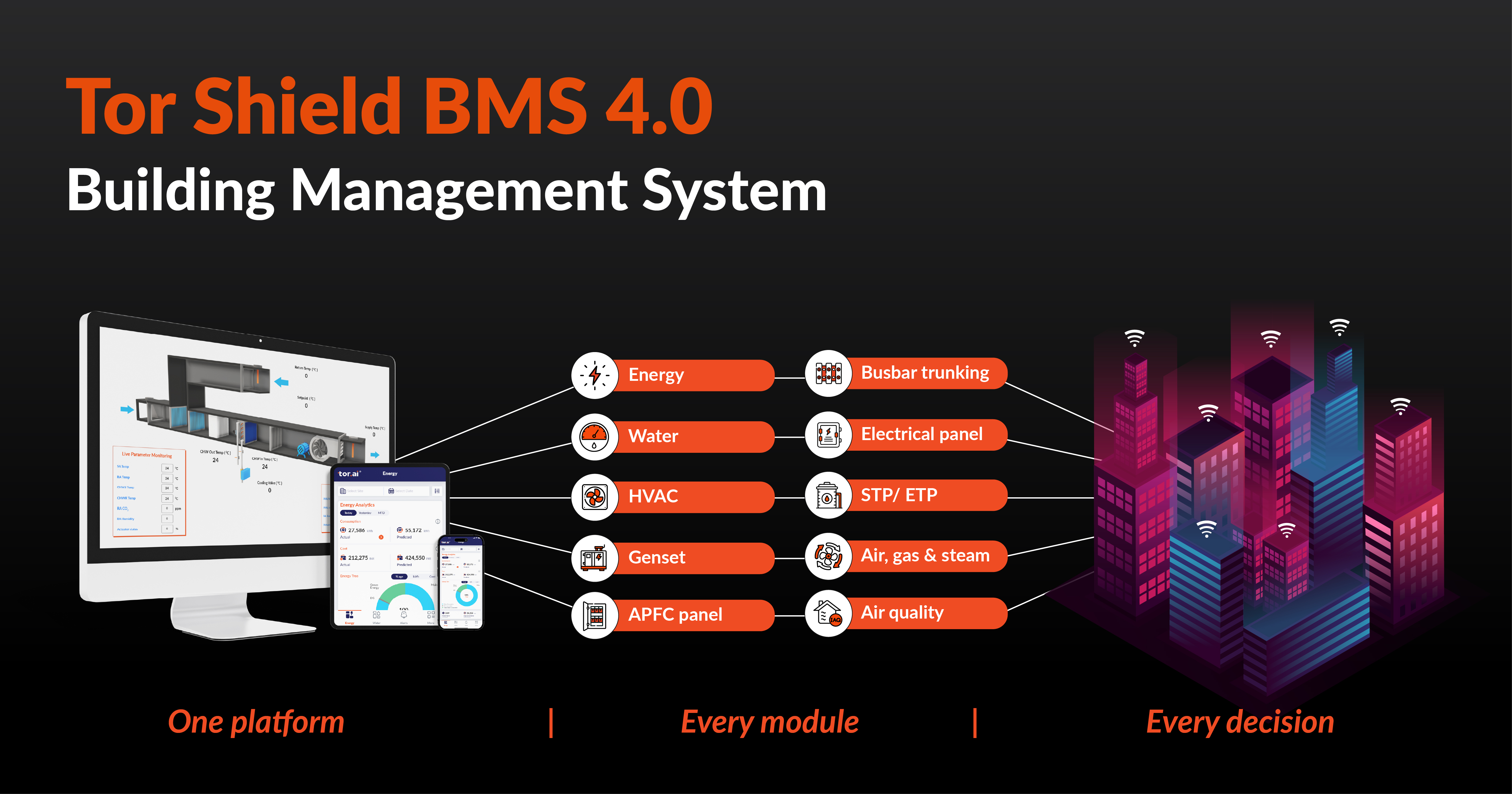
Tor Shield Integrated Building Management System: One platform, Every module, Every decision
- IBMS
The hidden cost of fragmented building management is not what you see on the utility bill. It is what you never see: the fault that wasn't detected in time, the demand penalty nobody anticipated, the energy waste that looked like normal operation because there was no baseline to compare it against. Most buildings are not unmanaged — they are poorly integrated, and that distinction carries a significant operational and financial price.
Tor Shield IBMS is designed around a direct answer to that problem. This piece examines what the platform delivers, how its modules address real operational gaps, and why the architectural decisions underneath the product matter as much as the features on top.
The Integration Problem, Stated Plainly
Hotels, hospitals, malls, and office complexes rarely lack building technology. What they lack is connected building technology. HVAC runs on one system. Access control runs on another. Energy data lives in a spreadsheet someone updates once a week. Fire panels are standalone. The facilities team becomes permanently reactive — chasing faults that could have been predicted, paying bills that could have been lower, and unable to give senior management a coherent performance picture because the data is scattered across multiple vendors and systems.
The architectural premise of Tor Shield is that this fragmentation is the core problem, not a side effect. The platform runs all modules on shared data infrastructure with unified alerting and cross-module intelligence. Individual features matter, but the platform architecture is what turns features into operational leverage.
Module One: HVAC Monitoring and Control
HVAC typically represents 40 to 60 percent of total energy spend in a commercial building. That proportion makes it the highest-leverage module in any integrated building management system, and it is where Tor Shield's technical depth is most evident.
Chiller Plant Management
The chiller plant is where energy waste concentrates and where management complexity is highest. Tor Shield integrates across multi-brand chiller environments — Carrier, Trane, Daikin, York, Kirloskar, Blue Star, and others — without requiring equipment replacement. This is a practical necessity in real facilities where equipment from different procurement cycles and different vendors must operate as a coordinated system.
Sequencing logic determines which chillers run and when additional units come online based on actual cooling demand, not time schedules or manual operator calls. Condenser and chilled water pumps are modulated via Variable Frequency Drives (VFDs) to match real-time flow requirements rather than running at constant speed regardless of load.
The system provides live kW per ton of refrigeration monitoring — a direct efficiency metric showing how many kilowatts are consumed per unit of cooling delivered. That single number becomes the shared benchmark for operational decisions and management reporting alike, replacing vague claims about efficiency with a measurable, accountable figure.
Cooling Tower Control
Cooling tower fan speeds are automatically modulated based on approach temperature — the relationship between condenser water return temperature and ambient wet-bulb conditions — so the tower does exactly the work required and no more.
Air Handling Unit Management
Tor Shield manages supply and return air temperature setpoints across Air Handling Units (AHUs), modulates chilled water valves for zone-specific cooling requirements, and controls fan speeds through VFD integration. Fresh air damper control is driven by live CO and CO₂ sensor readings rather than static percentages, so ventilation responds to actual occupancy and air quality conditions rather than assumptions about how full a space might be.
The compounding result: equipment running at optimized loads wears less quickly, occupants receive consistent air quality, and the facilities team is no longer dependent on the availability of a senior operator to sequence the plant correctly.
Module Two: Energy Monitoring
Monthly utility bills are a retrospective document. They describe what happened; they do not enable intervention. Manual meter reads introduce errors and timing gaps. Maximum demand breaches generate penalty charges before the threshold was even visible to the facilities team.
Tor Shield's Active Energy Monitoring replaces this with continuous, automated data collection across electrical infrastructure. The system tracks consumption at sufficient granularity to identify which loads are driving spend, surface anomalies in real time, and establish the performance baselines that any meaningful efficiency program requires.
This module is also the operational foundation for demand management — understanding load profiles well enough to shift or shed load before penalties are incurred, rather than discovering the breach after the fact.
OTHER KEY MODULES
Water Management
Tor Shield tracks water consumption source-wise, monitors tank levels in real time, detects leaks and overflows before they compound, and reconciles tanker deliveries against actual usage. Quality parameters are measured continuously where required. Water is one of the least-instrumented utilities in most commercial buildings — this module closes that gap.
Genset Monitoring
The system validates genset readiness before a power event, not after. It detects fuel pilferage to within one percent accuracy, flags idle-run waste, and analyses load patterns to inform capacity planning. For facilities where backup power is a continuity requirement — hospitals, data centres, hotels — genset visibility is non-negotiable.
APFC Panel Monitoring
APFC monitoring tracks power factor, flags harmonic distortion, and monitors capacitor bank health — catching degradation before it triggers utility penalties or downstream equipment damage.
Busbar Trunking Monitoring
Busbar trunking monitoring adds continuous thermal and current tracking across distribution risers, surfacing the slow-developing hotspots that conventional inspection cycles miss entirely.
STP/ETP Compliance Monitoring
Continuous automated measurement of BOD, COD, TSS, and pH replaces the manual logbooks and periodic sampling that most facilities still rely on. Digital audit trails and auto-generated compliance reports mean pollution board readiness is a default state, not a scramble triggered by an inspection notice.
Air Quality Monitoring
CO₂, PM2.5, PM10, TVOC, temperature, and humidity are monitored continuously. This serves two purposes: occupant health management in real time, and the documentation trail required for LEED and WELL certification. In the HVAC module, this data also drives fresh air damper control — another instance of cross-module intelligence.
Electrical Panel Monitoring
Panel temperature tracking and thermography data feed into fault prediction models that flag arc flash risk and insulation degradation before they escalate to unplanned shutdowns. This is predictive maintenance applied to electrical infrastructure — an area most facilities still manage through periodic manual thermography rounds.
Lighting Control
Occupancy-linked switching, time-based scheduling, dimming, and scene control operate through BACnet-compatible infrastructure. Lighting typically represents 15 to 25 percent of commercial building energy spend, and most of that waste is lights running in unoccupied spaces — a problem that scheduling and occupancy sensing eliminate without behavioural change.
Access Control and CCTV
Biometric, RFID, and turnstile systems are consolidated into the same platform alongside video analytics, including footfall tracking relevant to retail and hospitality operations. Integration with fire alarm protocols means access points respond automatically during emergency events rather than requiring manual intervention.
Fire Alarm Integration
On detection, the system automatically executes response protocols: HVAC dampers close to contain smoke spread, elevators recall, and alerts distribute via configured channels including WhatsApp. Detector health is monitored continuously so system readiness is verified before it is needed. This is the module where integration is not an efficiency play — it is a life safety requirement.
Tor Shield IBMS — Module architecture
16 modules, one unified data layer
Tor Shield
IBMS
Unified data layer
Where Cross-Module Intelligence Changes the Picture
The individual modules above are useful in isolation. The platform is where their value compounds.
Consider a specific scenario: supply air temperature in an AHU begins drifting upward. In a siloed environment, this eventually becomes a maintenance ticket. In Tor Shield, the same signal is correlated in real time with rising chilled water valve position, a declining kW per ton metric at the chiller plant, and a consumption increase visible on the relevant electrical circuit. The picture becomes diagnostic rather than merely descriptive.
This kind of cross-system correlation is only possible when HVAC, energy, air quality, and building systems data flows into a single platform with shared context. That is what the Tor Shield architecture is designed to enable.
It also reflects the broader approach of Tor.ai as a full-stack IoT company that designs and manufactures every layer of the stack — from sensors and controllers to gateways and the application platform itself. When a hardware vendor and software vendor are the same entity, there is no finger-pointing when something does not behave as expected. Accountability is singular, and the integration works because it was designed as a whole rather than assembled from parts.
Designed for Facilities as They Actually Are
A recurring failure pattern in building management technology is that products are designed for new construction — uniform equipment, clean electrical infrastructure, and a single procurement decision. Most buildings that need integrated management are nothing like that.
They have chillers from three procurement cycles. Electrical panels that predate smart metering. Control systems that speak different protocols. Tor Shield is built to operate in this environment rather than require replacement of it.
Multi-brand chiller integration without rip-and-replace is one expression of this design principle. Protocol support — native communication with industrial equipment via Modbus RTU/TCP, BACnet, and other industrial standards — is another. Deployment flexibility accommodates cloud, on-premises, and hybrid configurations, allowing facilities with data sensitivity requirements to maintain control over where operational data resides.
Three Roles, One Data Layer
Facility Heads, CFOs, and CTOs each have a different relationship with the data Tor Shield produces, and the platform is designed to serve all three from the same underlying layer without requiring separate systems for operational and financial visibility.
Facility Heads need real-time equipment status, fault alerts, and a way to manage their teams based on what the building is actually communicating — not reactive complaint management.
CFOs need financial accountability: energy spend broken down by floor, by system, by time of day; demand penalty risk; maintenance cost trends; and a defensible business case for efficiency investment.
CTOs and building technology leads need integration depth and scalability — a platform that reduces vendor complexity, supports open protocols, and can evolve as systems and requirements change.
The same data architecture that enables a facilities team to spot a chiller fault early also enables a CFO to see the cost implications of deferred maintenance and an energy efficiency gap that is costing the building on every utility cycle.
The Production Context Behind the Platform
Tor Shield is one of three products on the Tor.ai platform, alongside Tor Equip for equipment telematics and Tor Fleet for fleet management. All three share the same IoT platform, hardware families, and analytics engine, which means capabilities developed for one product become available across others.
For building operators in sectors where facility data and equipment performance data intersect — hospitals with critical medical equipment, facilities with production machinery — that shared stack creates possibilities that single-product BMS vendors cannot replicate.
Tor.ai has more than 500,000 active devices deployed across more than 100 customers, with manufacturing capacity of approximately 900,000 units annually from an IATF-16949 certified facility. This is a production-grade operation with an industrial-grade deployment record behind it.
The Question Worth Asking
Evaluating an integrated building management system is ultimately about what it makes possible that was not possible before. Earlier fault detection. Better energy decisions. Reduced dependency on individual operator expertise. A clear audit trail for energy and compliance reporting. A consolidated view of building performance that management can actually act on.
Tor Shield's module coverage — from multi-brand chiller plant management and AHU control to active energy monitoring — addresses those questions from a single integrated platform, without requiring a uniform equipment environment or a greenfield deployment.
If your facility is carrying the operational cost of fragmented systems, the case for examining Tor Shield in detail is straightforward.
Contact Tor.ai to explore how Tor Shield IBMS applies to your facility and sector.