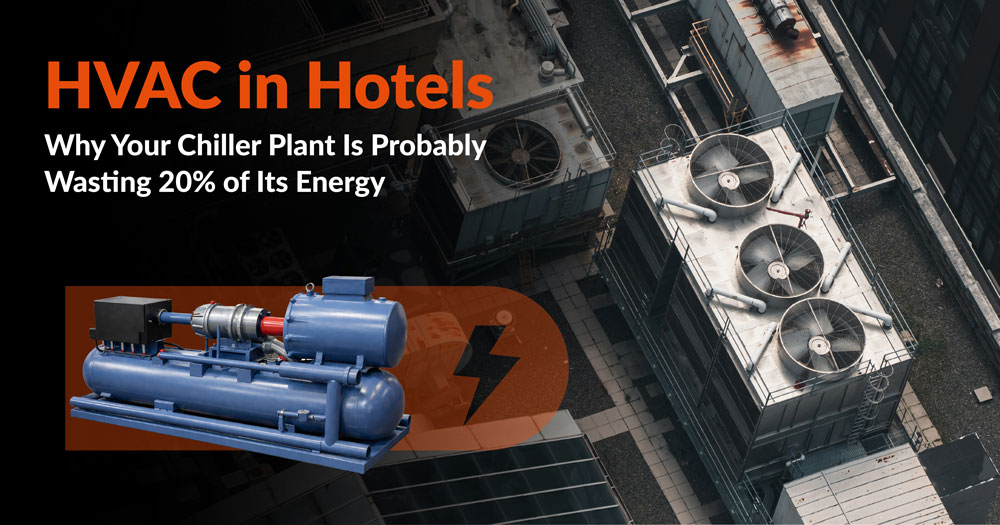
Why your Chiller Plant is probably wasting 20% of its energy
- IBMS
There is a number that almost every hotel engineering team should be uncomfortable with: the efficiency of their chiller plant right now, at this moment, as guests check in and housekeeping runs its cycles. Not at peak design load but at actual operating load, on an ordinary Tuesday afternoon in October.
Most hotel operators do not know that number. And that, more than any single piece of equipment failure, is why chiller plants in commercial hospitality buildings consistently underperform their potential.
This article takes a balanced look at where the waste actually comes from, why the picture is more nuanced than the typical "install VFDs and save 30%" pitch, and what a structured approach to chiller plant management genuinely looks like.
The Baseline Problem: You Cannot Optimize What You Cannot Measure
Before getting into specific inefficiencies, it is worth naming the root cause that sits beneath all of them.
HVAC is typically the single largest energy consumer in any commercial building — often 40–60% of total energy spend. In a hotel, that figure is amplified by 24/7 occupancy patterns, variable room loads, banquet and F&B operations, and the expectation that guests will never feel uncomfortable regardless of what is happening outside.
Yet most hotel facilities teams run chillers, cooling towers, and AHUs on fixed schedules and manual set-points. Nobody tracks the actual kW/TR (kilowatts consumed per ton of cooling delivered) in real time. There is no baseline, so there is no benchmark, and without a benchmark, there is no accountability.
This is not a criticism of facilities teams. It is a structural problem: the instrumentation and control systems that would surface this data are simply not in place in most properties. The result is that inefficiency accumulates invisibly, and the only signal that anything is wrong is the monthly electricity bill, by which point the waste has already happened.
Where the 20% Goes: Four Specific Mechanisms
1. Fixed-Speed Pumps and Fans Running at Full Load When They Do Not Need To
Chiller plants are engineered for peak cooling demand — a condition that, in most climates and building types, occurs perhaps 2–3% of annual operating hours. The rest of the time, the plant is serving a partial load: maybe 40%, maybe 60%, rarely the full design figure.
Without Variable Frequency Drives (VFDs) on condenser water pumps, chilled water pumps, and cooling tower fans, those motors run at full speed regardless of actual demand. This matters because of the affinity laws governing rotating equipment: power consumption is proportional to the cube of rotational speed. A 20% reduction in speed translates to approximately 49% reduction in power draw.
The implication is significant. If a hotel's chilled water pumps are running at full speed to serve 50% of design load, there is a large and readily recoverable energy gap sitting in that pump room.
The caveat that belongs here: The cubic relationship between speed and power assumes zero static head. In real pumping systems, particularly in multi-storey hotel buildings with meaningful vertical lift requirements, the actual savings are lower than the theoretical curve suggests. VFDs also introduce harmonic distortion that can cause chiller tripping or control system interference if not properly specified and filtered. These are real engineering considerations, not footnotes. A VFD installation without proper harmonic mitigation can create new problems while solving old ones.
The honest position: VFD retrofits on pumps and fans are generally well justified in hotel HVAC systems, but they require proper engineering, not just procurement.
2. Condenser Water Temperature Held at Design Conditions Year Round
Most chiller plants are commissioned with a condenser water set-point of 29–30°C, the design condition for a hot summer day. That set-point is then left unchanged for the rest of the year.
The problem is that ambient wet-bulb temperature varies considerably across seasons. On a mild day, a well-controlled cooling tower can deliver condenser water significantly colder than the design set-point, reducing the lift on the chiller compressor and improving Coefficient of Performance (COP). Industry data suggests that condenser water temperature reduction of one degree can reduce compressor power by 0.5–1%.
Across a year of operation, the cumulative opportunity from intelligent condenser water reset — adjusting the set-point dynamically based on actual ambient conditions rather than holding it fixed at the summer design value — is meaningful.
The caveat: There is a hard lower limit. Dropping condenser water temperature too far on centrifugal chillers can induce surge, a condition where refrigerant reverses flow through the compressor, causing rapid mechanical damage. Every chiller has a manufacturer specified minimum condensing temperature. Condenser water reset strategies must respect that floor, and the set-point logic needs to account for chiller type, refrigerant, and current operating conditions. Automated reset without these guardrails is not optimization; it is a maintenance liability.
3. Poor Chiller Sequencing
A hotel with multiple chillers, which is most mid-scale and large properties, faces a sequencing question every hour of every day: which chiller should be running, and at what load?
Without automated sequencing, the answer defaults to operator habit or schedule. This approach ignores the actual efficiency curve of each machine. Chillers typically have a sweet spot, often between 50–70% of full load, where they operate most efficiently.
Running one chiller at 90% load is often less efficient than running it at 70% and bringing a second machine online at partial load, depending on the specific efficiency curves involved.
The further complication in hotel environments is that chiller fleets are rarely homogeneous. A property that has been operating for fifteen or twenty years may have Carrier centrifugals installed in one phase, Trane units added in a subsequent expansion, and a Kirloskar or Blue Star package unit brought in as a temporary measure that became permanent. Sequencing across a mixed fleet, without integrated controls, depends entirely on the judgment and availability of a senior operator.
The caveat: Intelligent sequencing is not universally superior to simple scheduling in every scenario. During periods of very stable, predictable load, a skilled operator's pre-set schedule may perform comparably to algorithmic sequencing. The value of automation increases with load variability and with reduced operator availability, both of which are standard conditions in hotel operations.
4. AHU Operation Disconnected From Actual Zone Demand
Air Handling Units in hotel properties serve a wide range of spaces with very different occupancy profiles: guest floors, conference halls, restaurants, and lobbies all have different cooling and ventilation requirements.
Running all AHUs at the same supply air temperature set-point and the same fan speed on a fixed schedule guarantees overcooling in some zones and under-serving others. It also means that fresh air intake is governed by a static percentage assumption rather than actual indoor air quality.
In a partially occupied hotel, bringing in large volumes of unconditioned outside air to dilute CO₂ levels in nearly empty guest corridors is a direct energy cost with no guest comfort benefit.
What Honest Assessment Looks Like
The 20% figure in the title of this piece is a reasonable approximation for a hotel chiller plant with fixed-speed pumps, fixed condenser water set-points, manual sequencing, and schedule-based AHU control. But it is an approximation, not a guarantee.
The actual recoverable efficiency in any specific property depends on:
- The age and condition of existing equipment
- Whether VFDs are already in place on any circuits
- The load profile and occupancy patterns of the property
- The quality of the existing BMS, if any
- The skill and consistency of the facilities team
Properties that have already invested in partial automation will see smaller gains from incremental improvements. Properties running old, fixed-speed equipment across the full plant will see larger ones. The honest answer to "how much can we recover?" is: measure first, then estimate.
What is consistent across properties is that without real-time kW/TR monitoring, the question cannot even be answered and cannot be improved upon.
The Case for Integrated Automation and Its Limits
Automated chiller plant management, when properly implemented, addresses the four mechanisms above in a coordinated way. Pumps and fans respond to actual load via VFDs. Condenser water set-points reset dynamically within safe operating limits. Chiller sequencing responds to demand signals rather than clocks. AHU fan speeds and valve positions modulate to zone requirements.
The important qualification is "when properly implemented." Automation that is not configured to respect equipment limits, commissioned against real operating data, or maintained as the building's load profile changes over time can underperform or create new problems.
The goal is not automation for its own sake. It is demand-driven operation — the plant doing exactly what the building needs, no more and no less, at every hour of the day.
Tor Shield IBMS: Purpose-Built for This Problem
If you are evaluating how to move from fixed-schedule operation to demand-driven chiller plant management, Tor Shield's IBMS HVAC module is designed specifically for this use case in commercial buildings.
Chiller Plant Management (CPM)
Tor Shield integrates across multi-brand chiller fleets — Carrier, Trane, Daikin, York, Kirloskar, Blue Star, or any combination — without requiring single-vendor lock-in. It handles intelligent chiller sequencing, demand-based automated on/off control, and pump modulation via VFDs to match actual flow requirements. Real-time kW/TR monitoring gives facilities teams a live efficiency metric to track, benchmark, and act on.
Cooling Tower Automation
Fan speed is modulated based on approach temperature — the difference between condenser water return temperature and ambient wet-bulb conditions — ensuring the tower does exactly enough work to maintain condenser water temperature without overcooling or undercooling.
AHU Automation
Centralized set-point management, chilled water valve modulation, fan speed control via VFDs, and fresh air automation based on live CO/CO₂ readings ensure ventilation responds to actual occupancy rather than assumptions.
The outcome is a chiller plant that operates on actual demand signals across all three layers, with the visibility to measure what is happening and the control to act on it.
To learn more about how Tor Shield IBMS approaches chiller plant management and what integrated HVAC automation looks like in practice, explore the full HVAC module documentation and see how the platform fits your property's specific configuration.
Conclusion
The waste in chiller plants is real, it is measurable, and it is recoverable. But recovering it requires more than a product decision; it requires an honest assessment of where your plant stands today and a structured approach to closing the gap. Start with the data. The optimization follows.