Case study
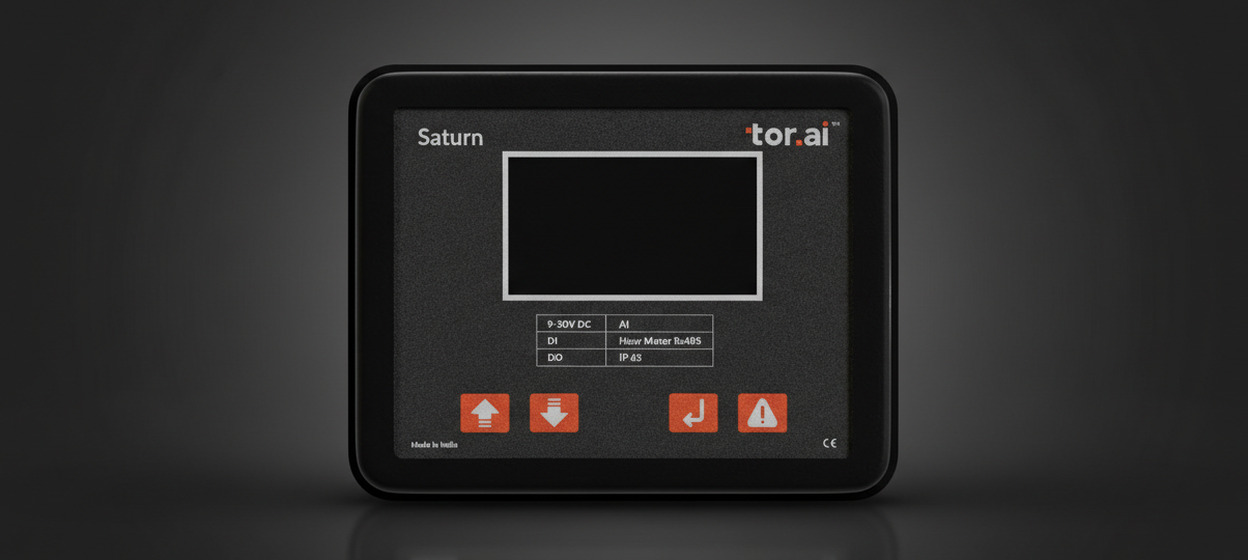
Tor Shield Integrated Building Management System
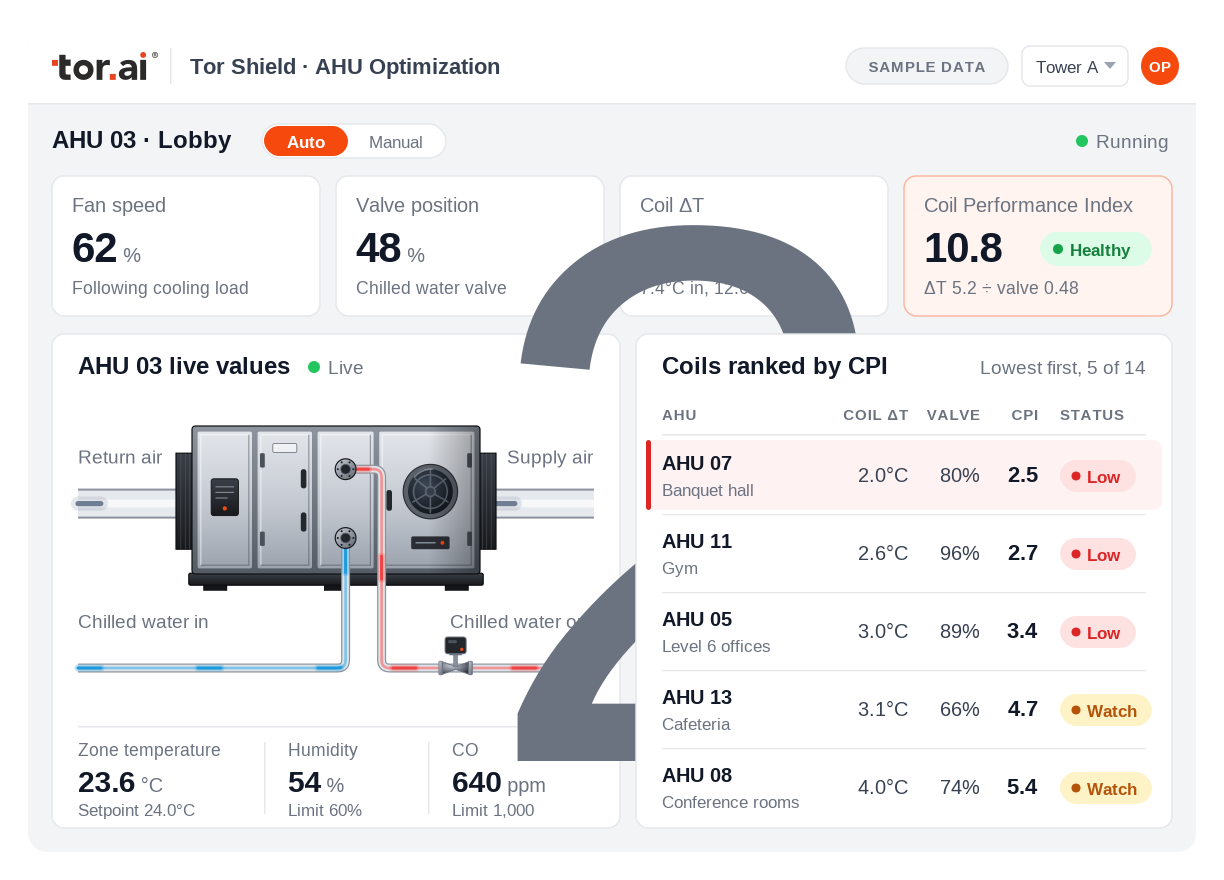
Tor Shield controls chilled water valves, fan speed, temperature, and humidity at every AHU, and ranks each coil by performance. It minimises total HVAC power by 15–30%.
Case study
Trusted by industry leaders








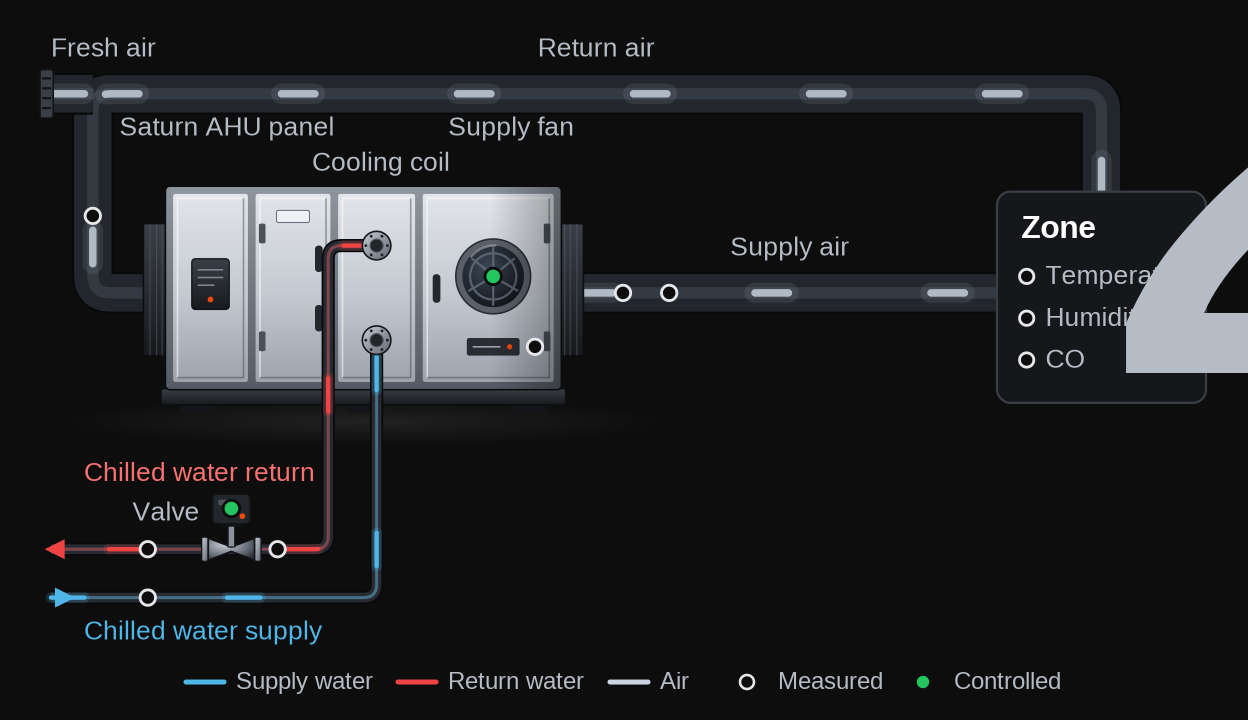
Your AHUs, annotated
Chilled water valve
Supply fan
Zone
| Equipment | What we measure | What we control |
|---|---|---|
| Chilled water valve | Valve position, chilled water supply and return temperatures | Modulating position, giving the coil only the flow it needs to protect ΔT |
| Supply fan | Fan speed, supply and return air temperature, duct pressure | Fan speed on cooling load, CO₂ or duct pressure |
| Zone | Temperature, humidity, CO₂ where fitted | Temperature held to setpoint; humidity monitored and limited |
Every AHU's ΔT, CPI and energy feed Tor SOLACE's whole-system optimisation and your dashboard.
Low ΔT and the Coil Performance Index
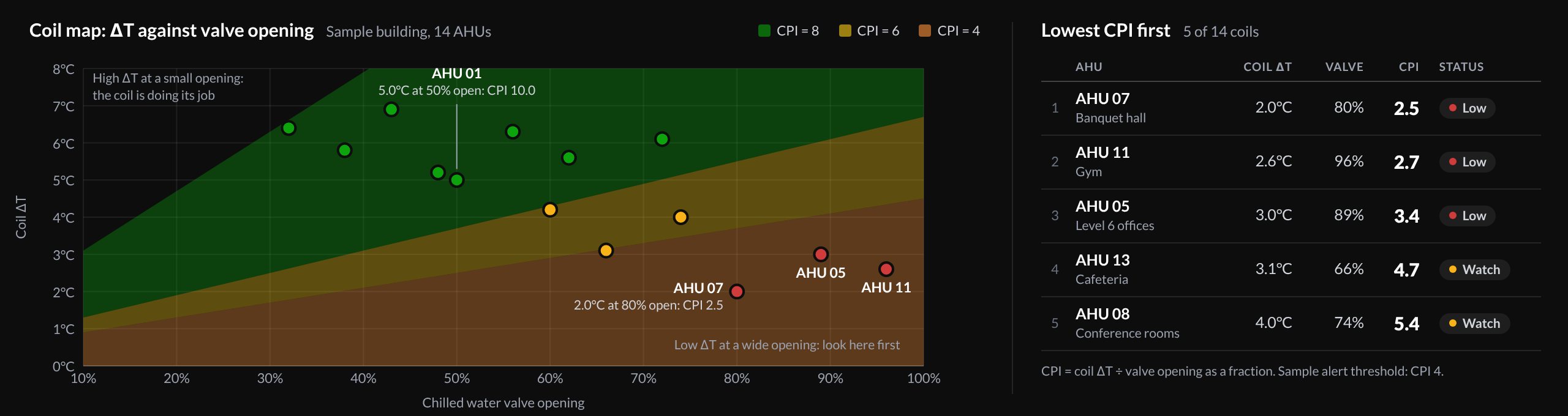
Part of Tor SOLACELow ΔT is a building-wide symptom with a few local causes. A coil at 2°C ΔT makes the plant pump three times the water it would at 6°C. Energy valves on every AHU would find them, at a high price. Tor Shield scores every coil from its ΔT and valve position instead.
Coil Performance Index = coil ΔT ÷ valve opening
A healthy coil delivering 5°C of ΔT at 50% open scores 10. A coil delivering 2°C at 80% open scores 2.5. Every AHU gets a score, an alert threshold, and a place in the ranking.
CPI points your maintenance team to the coil that needs attention. With Tor SOLACE, the same signal drives chilled water valve positions automatically.
If the coil's CPI is low, the valve is over 30% open, and…
The room is at setpoint, return-minus-supply air temperature is normal, and pump or header pressure is high
… the likely cause is
Too much water: overflow or over-pumping (ΔT syndrome)
If the coil's CPI is low, the valve is over 30% open, and…
The room is not at setpoint, return-minus-supply air temperature is high, and the fan is at full speed
… the likely cause is
An air-side problem: coil fouling, low airflow or a choked filter
| If the coil's CPI is low, the valve is over 30% open, and… | … the likely cause is |
|---|---|
| The room is at setpoint, return-minus-supply air temperature is normal, and pump or header pressure is high | Too much water: overflow or over-pumping (ΔT syndrome) |
| The room is not at setpoint, return-minus-supply air temperature is high, and the fan is at full speed | An air-side problem: coil fouling, low airflow or a choked filter |
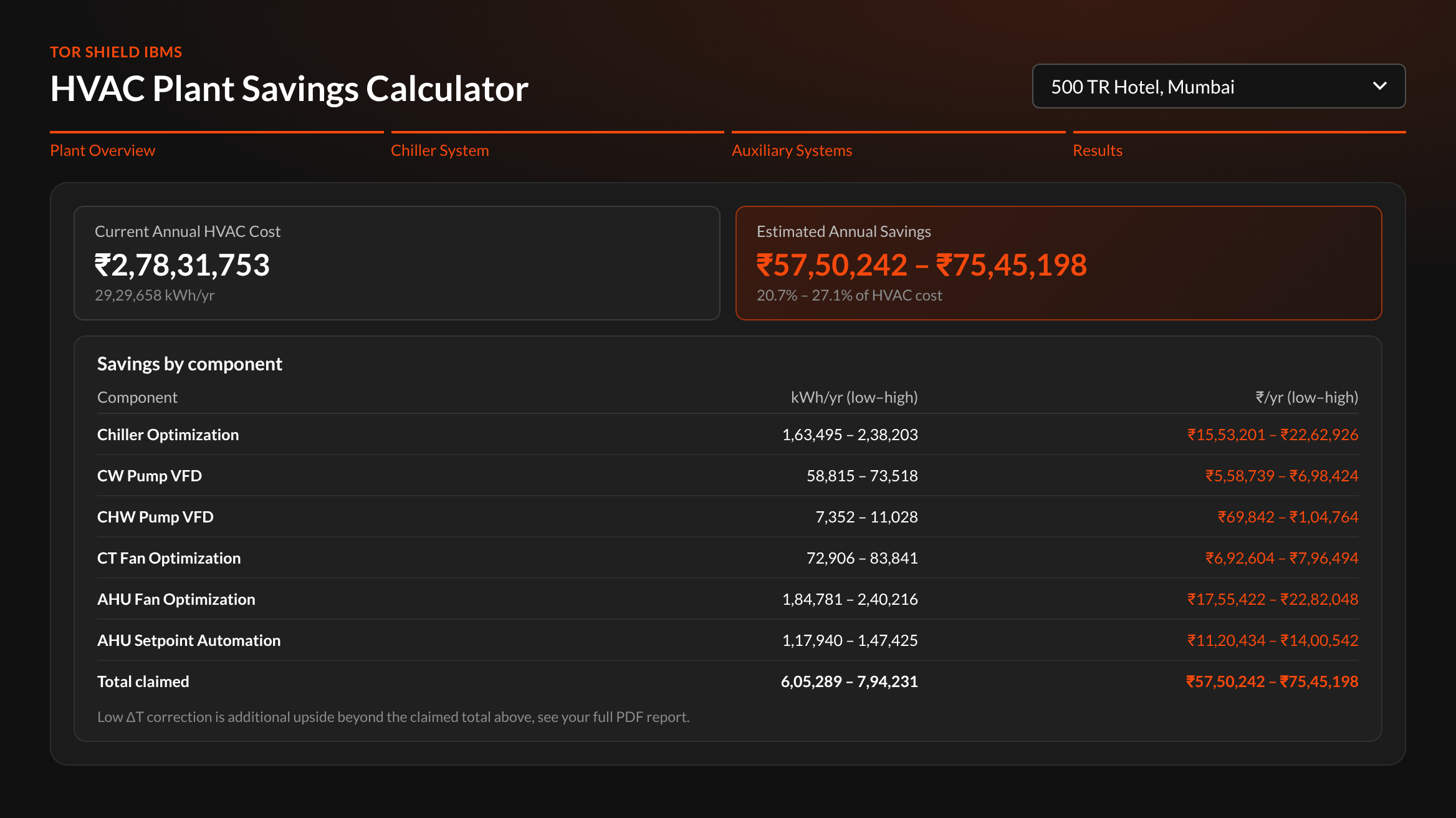
Estimate your savings
Use our savings calculator for your hotel, hospital, mall or commercial building. Enter your chillers, pumps, cooling towers and AHUs to get a savings range for each subsystem and your plant's current IKW.
Integration and hardware
You choose where the platform runs.
Every AHU has an Auto/ Manual mode & an on/off control on the DDC panel & dashboard.
Several buildings on one dashboard, with remote diagnostics.
Configurable interlocks stop operation outside the limits you set.
FAQ
Yes. Fan control works with on/off fans, and adding a VFD unlocks speed savings. The coil needs a modulating valve; manual butterfly valves need replacing first.
Not to find the problem. The Coil Performance Index uses valve position and ΔT to rank coils, so you can fix the worst first and decide where an energy valve is worth it.
Only where you want ventilation-based fan control. Fans can also run on load or duct pressure.
Yes. Any AHU can be switched to Manual from the dashboard.
Yes. AHU Optimization runs on its own; with Chiller Plant Manager, the plant also benefits from better ΔT.
Total HVAC optimisation
HVAC accounts for around 60% of a commercial building's energy consumption, yet its subsystems are typically controlled in isolation. Each holds its own setpoint, often at the expense of the others: a higher chilled water setpoint reduces chiller power but increases pump and AHU fan energy. Low ΔT syndrome, efficiency drift in ageing assets, and continuous variation in occupancy and ambient conditions compound the loss. Sustained savings require coordinated control across the entire HVAC system.